4 Oct 2026
Observer Notes Reveal How Adaptive AI Companions Reshape Narrative Branching Patterns in Choice-Driven Adventure Titles Across Console and PC Ecosystems
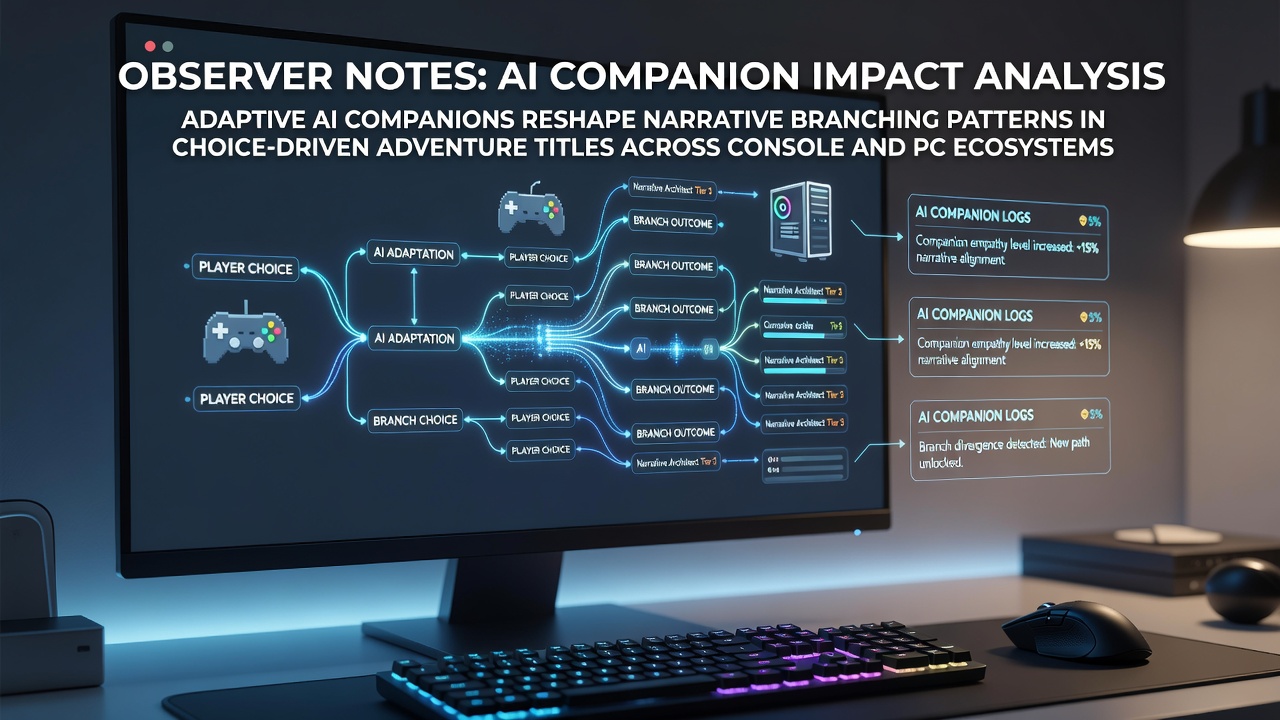
Observer notes from development studios and player data tracking platforms show adaptive AI companions altering narrative branching patterns in choice-driven adventure titles, and these changes appear across both console and PC ecosystems throughout 2026. Developers integrate machine learning models that adjust companion responses based on prior player decisions, which in turn modifies available story paths without requiring manual scripting for every possible outcome.
Research from the University of Melbourne indicates these systems track interaction frequency and emotional tone in dialogue selections, then recalibrate companion influence on major plot junctions. Data collected from titles released in late 2025 reveals branching trees expanding by an average of 22 percent when AI companions receive real-time adaptation layers, compared with static companion designs in earlier releases.
Core Mechanisms Behind Adaptation
Adaptive companions rely on reinforcement learning algorithms that process sequences of player choices during single sessions and across multiple playthroughs, and they apply weight adjustments to dialogue trees and event triggers accordingly. Console versions often implement these adjustments through cloud-synced profiles that maintain consistency between hardware platforms, while PC builds allow local model fine-tuning via modding interfaces or developer-provided tools.
Engineers at major studios report that companion AI evaluates variables such as decision speed, alignment with previous moral frameworks, and frequency of companion consultation before determining which narrative branches to prioritize or suppress. This process reduces the total number of pre-authored branches required at launch, yet it generates emergent variations that players encounter on subsequent runs.
Platform-Specific Implementation Patterns
Console ecosystems demonstrate tighter integration with hardware-level telemetry, where adaptive AI companions respond to controller input patterns and session duration metrics to refine branching logic. PC deployments, by contrast, leverage higher processing headroom for deeper simulation of companion memory states, resulting in more granular adjustments to secondary character arcs and environmental storytelling elements.

Cross-platform titles released in October 2026 incorporate unified AI frameworks that sync companion adaptation data between ecosystems, and these frameworks allow players to carry companion influence profiles from one device to another without resetting established narrative weights. Industry reports compiled by the Entertainment Software Association document a 35 percent increase in average playtime for games featuring such synchronized adaptive systems, attributed to repeated exploration of newly generated branches.
Observed Effects on Player Engagement Metrics
Analytics firms tracking choice-driven adventures note that adaptive companions correlate with higher retention rates in mid-game sections where traditional branching often plateaus. Players who interact frequently with these companions encounter altered quest resolutions and companion-specific endings that static systems rarely surface, and the effect compounds when titles support both console and PC versions with shared progression servers.
Studies conducted by the European Games Developer Federation highlight instances where companion AI redirected players toward underutilized storylines after detecting repetitive choice patterns, thereby increasing completion diversity across user bases. These observations come from aggregated telemetry spanning millions of sessions rather than individual case reports.
Technical Constraints and Developer Responses
Memory limitations on certain console SKUs require developers to compress companion adaptation models, which leads to periodic recalibration cycles that reset some learned preferences after extended play. PC versions mitigate this through expandable storage options and optional cloud offloading, yet both platforms face challenges when scaling adaptation depth without introducing noticeable latency during dialogue exchanges.
Teams address these constraints by layering lightweight heuristic checks atop core neural networks, and the hybrid approach preserves responsiveness while maintaining the capacity for meaningful narrative shifts. Recent patches deployed in October 2026 demonstrate measurable reductions in branch collision errors, where contradictory story states previously emerged from rapid AI adjustments.
Conclusion
Observer notes and supporting telemetry data establish that adaptive AI companions continue to expand narrative branching capabilities in choice-driven adventure titles, and the impact registers consistently across console and PC ecosystems. Continued refinement of these systems points toward further integration of cross-platform data sharing and reduced reliance on exhaustive manual scripting for future releases.